
For most Puget Sound homes replacing a working tank, another tank is the simpler and cheaper choice. A tankless heater earns its higher price in a gas house with two or more bathrooms and years of living ahead in it. Our soft water works in tankless's favor here, while winter windstorms and older gas lines are the catches.
We install and service both kinds across Seattle and Snohomish County, and the right answer depends less on the brochure than on the house: what fuel it has, how its gas line and vent are set up, how many people shower in the morning, and how the household feels about losing hot water when the power goes out. Here is how we weigh it.
How a Tank and a Tankless Heater Differ
A tank
A tank heats forty or fifty gallons and keeps it hot until you need it. Its gas burner is small, about 40,000 BTU an hour on the tanks we replaced this fall, so it runs on the gas line most houses already have, and it costs the least to install. The trade-offs are the energy spent keeping that water hot around the clock and a working life of roughly ten to fifteen years.
A tankless heater
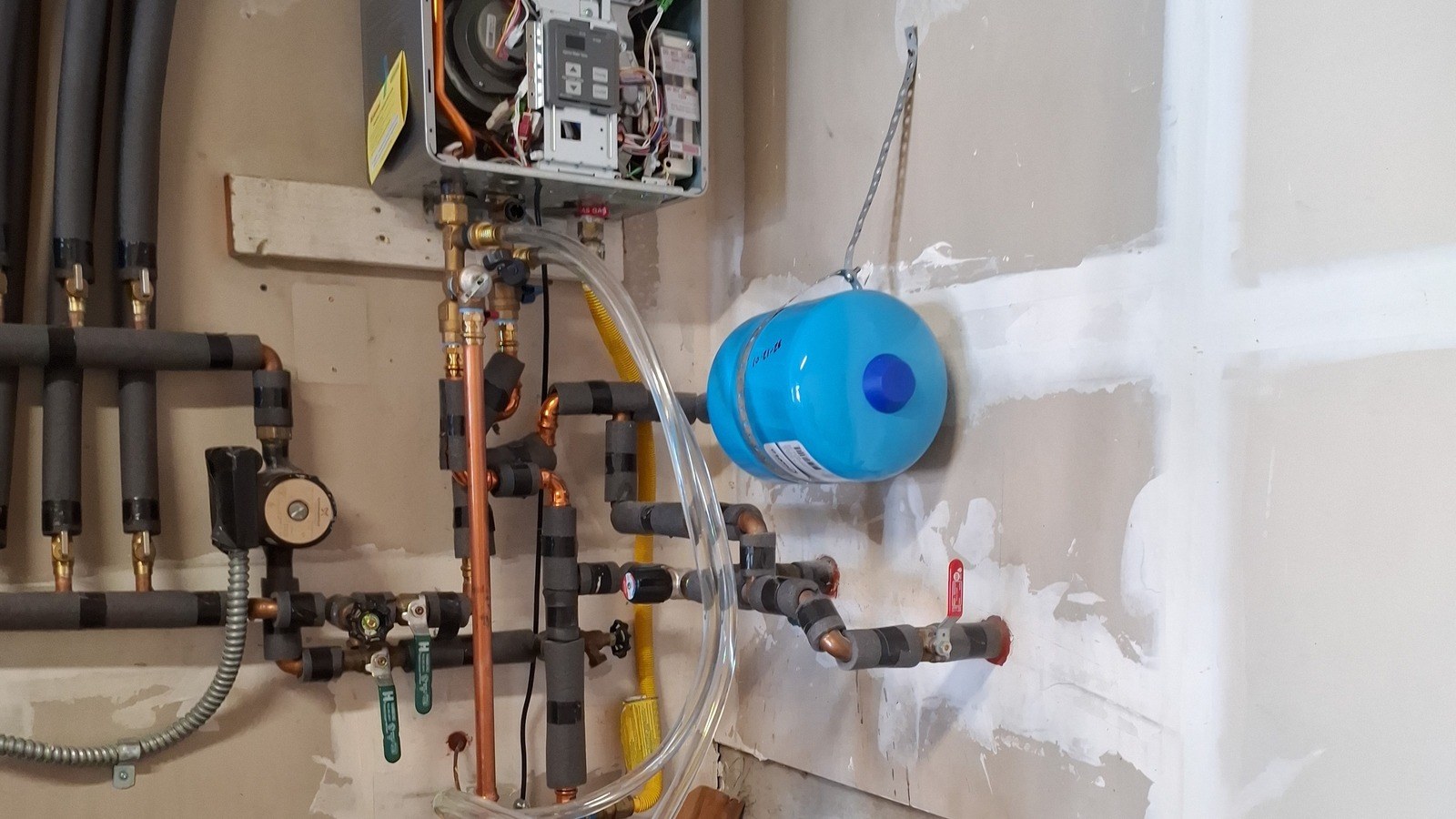
A tankless heater fires only when a tap opens, so nothing is kept hot on standby and it never runs out. To heat water that quickly, a whole-house gas unit burns roughly 150,000 to 200,000 BTU an hour, which often means a larger gas line, its own venting and an outlet for its controls. It costs two to three times as much to install as a tank and lasts twenty years or more with maintenance.
What Decides It in a Puget Sound House
1. Whether your tank has already failed
When a tank fails, the quickest way back to hot water is another tank, often the same day. In October, Joseph T. replaced a 2017 gas tank in a Mount Baker home with a new forty-gallon tank in a single visit. A tankless changeover can take longer, because the gas line and the venting have to be sized and planned first. If you want tankless, the time to decide is while the old tank still works.
2. Your gas line and your vent
A tank uses a quarter or less of the gas a whole-house tankless unit does, so a gas line that has fed a tank for decades may be too small for tankless, and upsizing it adds to the cost. Venting matters for both kinds. In Eastlake this month, a failed tank's vent sloped the wrong way, and the fix was a fifty-gallon power-vent tank with a fan and a PVC vent run through the wall; the Eastlake story has the details.
3. Our soft water
Scale is the main enemy of a tankless heat exchanger, and the Puget Sound area has some of the softest water in the country. Seattle's runs about one to two grains per gallon, and the Spada Lake water that Everett supplies to most of Snohomish County is soft as well. That slows scale down, but it does not end maintenance. In October, Nick and Jeremy gave a tankless heater in Madison Valley a descaling flush, cleaned its vent, inspected and cleaned its internal parts, and replaced a failed expansion tank.
A service visit is usually short, too. After a water heater service in Bothell this July, Kathryn M. wrote:
"Service folks were knowledgeable and most pleasant to work with. Water heater maintenance completed in a short time and all steps explained."
Kathryn M., Google review
4. Windstorms and power outages
Western Washington loses power in winter windstorms, sometimes for days. The bomb cyclone of November 2024 cut power to more than 600,000 people across the region, more than 400,000 of them Puget Sound Energy customers. A gas tankless heater needs electricity for its controls and fan, and so does a power-vent tank. Most standard natural-draft gas tanks run their controls off the pilot flame and keep heating through an outage.
5. How long you will be in the house
Tankless pays back slowly. The U.S. Department of Energy puts the savings at 24 to 34 percent of water heating energy for a home that uses 41 gallons of hot water a day or less, and a tankless unit can outlast two tanks. If you plan to stay five years or more and your household uses plenty of hot water, the math can work; if you may sell sooner, a new tank usually makes more sense.
Where a Heat Pump Water Heater Fits
If your house has no gas, the choice is not really tank or tankless. It is a standard electric tank or a heat pump water heater, a tank that heats with a heat pump and uses far less electricity. Seattle City Light offers a $750 rebate on qualifying units, and Snohomish County PUD has its own rebate when one replaces an existing water heater. They need room to breathe and a condensate drain, so they suit a garage or basement, and our Seattle water heater questions go into the details.
FAQs About Tank and Tankless Water Heaters
Will I still have hot water during a power outage?
It depends on the heater. Most standard natural-draft gas tanks keep heating, because their controls run off the pilot flame. An electric tank stops heating but holds its hot water for a while. A gas tankless heater and a power-vent tank both need electricity, so they stop when the power does.
Does a tankless heater still need descaling with our soft water?
Yes, though less urgently than in a hard-water city. Soft water slows scale down without stopping it, and Navien, for one, ties its heat exchanger warranty to annual maintenance. A service visit covers more than scale, too: the Madison Valley unit we serviced in October also had its vent and internal parts cleaned.
Can I switch to tankless the day my tank fails?
Sometimes, but it is rarely the best day to do it. A changeover may need a larger gas line, new venting, a condensate drain and an outlet, which take planning and sometimes permits. When a tank fails, we can usually replace it with another the same day, so make the tankless decision while the old tank still works.
Is a bigger tank an alternative to going tankless?
Often, if the problem is running out of hot water. Moving from a forty-gallon tank to a fifty, as the Eastlake home did this month, adds a quarter more stored hot water for far less than a tankless conversion. Newer tanks are wider and taller than older ones, though, so we measure the space before ordering.
Our Recommendation
Replace a failed tank with a tank, the same day, and do not let a breakdown push you into a rushed conversion. If you are planning ahead, choose tankless when the house has gas, two or more bathrooms and a household that runs out of hot water, and when you expect to stay five years or more; we will check the gas line and the venting before we quote it. Everywhere else, and especially in a small household or a house without gas, a well-installed tank or a heat pump water heater is the better buy.
Call About a New Water Heater
Not sure which way to go? Call for a free estimate, or request a callback, and send a photo of your current heater's label so we can tell you what it is and what it would take to change it.
More: water heater installation · tankless water heater installation · water heater repair · water heater replacement in Seattle · water heaters in Lynnwood · the Eastlake power-vent swap · gas line installation